
Remember that Mohanlal scene in Drishyam where he’s sitting in the police station, and his face shows everything – fear, determination, love for his family – all without saying much?
Or that moment in Manichithrathazhu when Ganga sees the anklet (chilanka) and her face lights up with pure joy?
That’s exactly what your child is learning in Bharatanatyam class. Except instead of doing it once for a camera, they’re learning to do it on command, repeatedly, with precision.
Welcome to the world of Navarasas – the 9 fundamental emotions that form the backbone of classical Indian dance.
What’s a Rasa Anyway?
Simple answer: It’s the feeling that reaches the audience’s heart.
Think of it like this – when you cook sambar, you add different ingredients. But the final taste that makes someone go “Wow!”? That’s not just the dal or the tamarind. It’s the whole experience.
In dance, Rasa is that “wow” feeling the audience gets.
The word literally means “juice” or “essence” – like how you extract juice from a fruit. Dancers extract the essence of an emotion and present it to you.
The 9 Emotions (Yes, Just 9!)
Ancient scholars believed all human emotions can be grouped into 9 categories. Let me introduce them in a way that makes sense:
1. Shringar (Love/Beauty)
The “Romance” Emotion
You know that look in Kannada movies when the hero sees the heroine for the first time? Eyes slightly widened, soft smile, maybe a gentle tilt of the head? That’s Shringar.
In real life: When your child sees their favorite sweet after dinner.
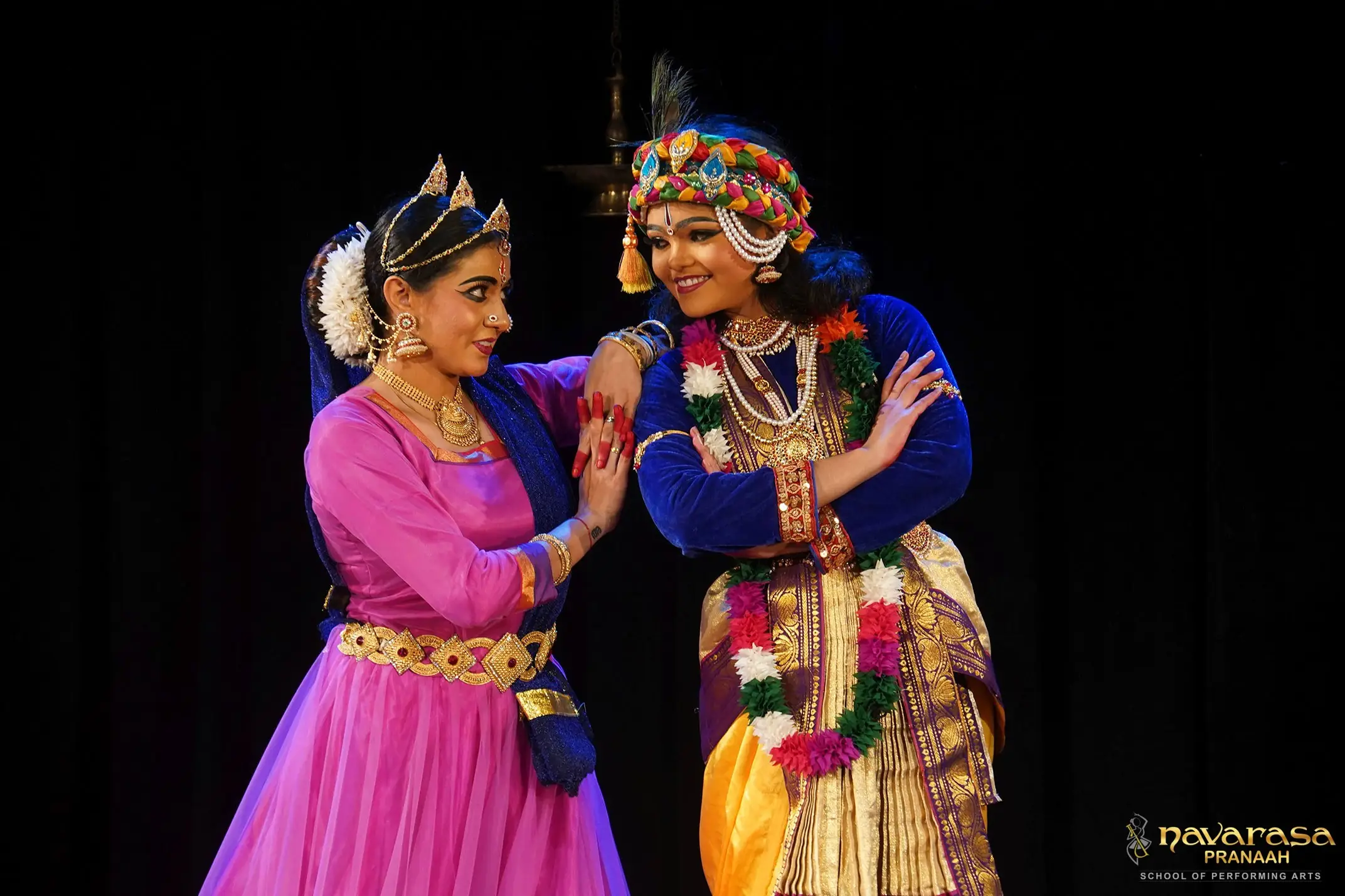
In dance: Radha waiting for Krishna, expressed through soft glances and graceful hand movements.
2. Hasya (Joy/Laughter)
The “Comedy” Emotion
Think of Jaggesh’s expressions in any comedy scene – pure mischief and fun!
In real life: Your 8-year-old who just successfully blamed their sibling for breaking something.
In dance: Little Krishna stealing butter, with playful eyes and tiptoeing movements.
3. Karuna (Sadness/Compassion)
The “Tissue Box” Emotion
That Mammootty scene in Oru Vadakkan Veeragatha when he realizes the truth? The eyes say everything.
In real life: When your child doesn’t get selected for the school play.
In dance: Sita separated from Rama – drooping shoulders, tears in eyes, hands reaching out.
4. Raudra (Anger/Fury)
The “Don’t Test Me” Emotion
Sudeep’s angry face in Eega. Enough said.
In real life: Your child when their sibling touches their toys.
In dance: Goddess Durga fighting the demon – fierce eyes, stamping feet, powerful gestures.
5. Veera (Courage/Heroism)
The “Mass Entry” Emotion
Every hero’s slow-motion walk in any mass scene. Chest out, confident gaze.
In real life: Your 10-year-old walking in after winning the school competition.
In dance: Rama preparing for battle – strong stance, steady gaze, fearless expression.
6. Bhayanaka (Fear)
The “Horror Movie” Emotion
That moment in Manichitrathazhu when Shobana first sees something scary.
In real life: Your child during their first injection.
In dance: Draupadi during the dice game – trembling hands, wide eyes, protective gestures.
7. Bibhatsa (Disgust)
The “Eww, No!” Emotion
Your face when you open last week’s forgotten lunch box.
In real life: Your child’s reaction to vegetables on their plate.
In dance: Rejecting injustice or wrongdoing – turned away face, hand covering mouth.
8. Adbhuta (Wonder/Amazement)
The “Whoa!” Emotion
That kid’s face at Wonderla seeing their first roller coaster.
In real life: Your child opening their birthday gift.
In dance: Yasoda seeing the universe in baby Krishna’s mouth – wide eyes, hands raised in astonishment.
9. Shanta (Peace/Tranquility)
The “After Yoga” Emotion
That peaceful face after finally putting your kids to sleep. Pure serenity.
In real life: Sunday morning, everyone’s still asleep, you’re sipping coffee.
In dance: The closing prayer – serene face, gentle movements, inner peace.
Why Should You Care?
Here’s the thing – when your child learns these emotions in dance, they’re not just “acting.”
They’re learning:
Emotional Intelligence – Recognizing and naming what they feel
Empathy – Understanding how others feel
Expression – Showing emotions in healthy ways
Control – Accessing emotions on demand (super useful skill!)
What This Means for Your Child’s Classes
When your child comes home and says “Today we learned Karuna,” they’ve spent an hour:
- Understanding sadness (Why is Sita sad?)
- Feeling it themselves (How would I feel?)
- Showing it precisely (Eyes, face, body, hands – all coordinated)
- Doing it repeatedly until it looks natural
That’s why they’re exhausted. They’re not just moving their body – they’re processing complex emotions and learning to communicate them clearly.
Pretty impressive for a 10-year-old, right?
Next in this series: “How Dancers Actually Create These Emotions (It’s Not Magic, It’s Science!)” – Read Here
Have you spotted these 9 emotions in your child’s performances? Which one do they express best? Share in the comments!