
You know that moment in your child’s performance when they become someone else?
When your giggly 9-year-old suddenly looks like a lovelorn Radha, or your shy 12-year-old channels the fury of Goddess Durga?You probably thought: “Wow, my child can act!”
But here’s the thing – it’s not acting. It’s Abhinaya.
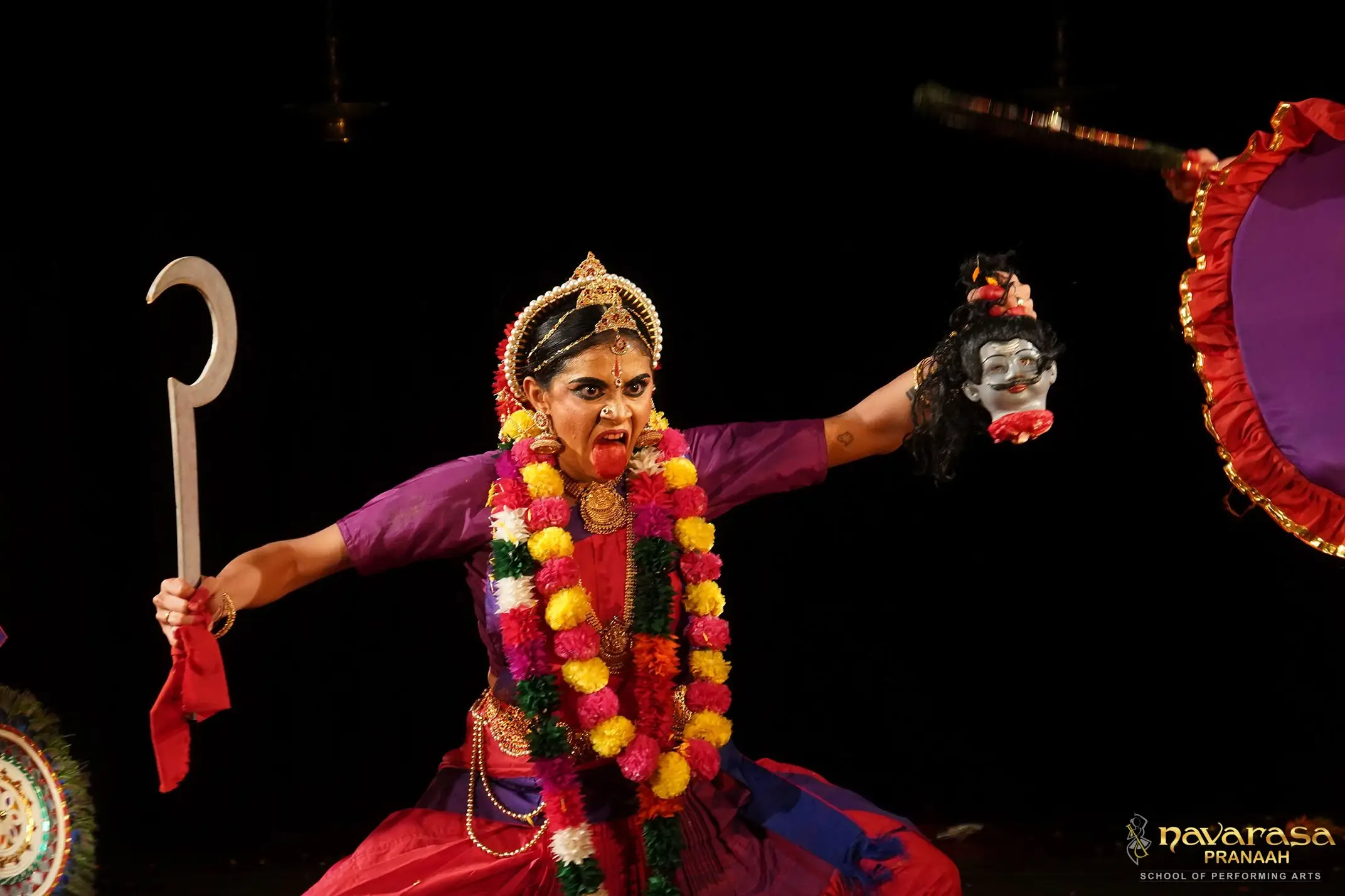
Acting vs. Abhinaya: What’s the Difference?
Acting (like in movies): Be realistic. If you’re sad, cry real tears. If you’re angry, actually shout.
Abhinaya (in dance): Be symbolic. Show sadness through controlled eye movements and specific hand gestures. Make anger powerful but precise.
Think of it like the difference between:
- Speaking normally vs. singing a classical raga
- Casual writing vs. poetry
- A phone photo vs. a painted portrait
Both communicate, but one is stylized, refined, and follows specific rules.
The 4 Secret Ingredients of Abhinaya
Remember the old Rasna ad – “I love you Rasna”? To make that drink, you need the concentrate, water, sugar. Similarly, to create emotion on stage, dancers use 4 specific ingredients:
1. Angika Abhinaya (Body Language)
This is what parents notice most. It’s everything physical:
The Face:
- Eyes do 70% of the work (that’s why we spend HOURS on eye exercises)
- Eyebrows add meaning (raised = surprise, furrowed = anger)
- Lips complete the expression (smile, pout, or neutral)
Fun fact: Your child practices 20+ different eye movements. Left, right, up, down, diagonal, circular. Like their eyes are doing calisthenics!
The Body:
- Hands in specific gestures (mudras) that mean things
- Posture that shows character (proud king vs. humble devotee)
- Movements that convey emotion (sharp for anger, soft for love)
Real talk: This is why your child stands in front of the mirror making faces for 20 minutes. They’re not being vain – they’re training!
2. Vachika Abhinaya (The Words)
Even though your child might not sing while dancing, understanding the lyrics is crucial.
It’s like watching a Malayalam movie without subtitles vs. with subtitles. Same scenes, but one makes so much more sense! When dancers know the meaning, their expression becomes authentic. They’re not just making faces – they’re telling the story.
Example:
- Words say: “Where are you, Krishna?”
- Generic expression: Sad face
- Abhinaya with understanding: Looking around searchingly (where?), hand on heart (longing), eyes showing hope mixed with despair (complex emotion)
3. Aharya Abhinaya (Costume & Makeup)
This is the fun part parents love! The costume isn’t just pretty – it’s telling a story:
- Red border saree = Married woman
- Crown = Royalty
- Third eye drawn = Lord Shiva
- Peacock feather = Krishna
Think of it like emoji. When you send 👑, people know you mean royalty. The costume does the same job.
Why teachers are particular about costume: It’s not us being fussy. A wrong costume is like watching Bahubali wear a t-shirt and jeans. Technically possible, but… wrong.
4. Sattvika Abhinaya (The Involuntary Stuff)
This is the highest level – when emotion becomes SO real that the body responds naturally:
- Actual tears during sad scenes
- Voice breaking with emotion
- Goosebumps during devotional pieces
- Trembling during fear
You can’t fake this. It just happens when a dancer is truly immersed.
Parent story: I once had a student performing a Karuna piece. Her grandmother had passed away recently. During the performance, real tears flowed. The audience was moved to silence. That’s Sattvika Abhinaya.
(Don’t worry – we don’t traumatize students to achieve this! It comes naturally with years of practice and emotional maturity.)
The Training Process (What Really Happens in Class)
Beginners (First 2 years):
“Show me a happy face. Now sad. Now angry.” Basic facial control – like teaching them to use their face muscles the way they use their hands.
What it looks like:
- Lots of mirror work
- Exaggerated expressions initially (better than no expression!)
- Simple stories (Krishna stole butter – show mischief!)
Intermediate (Years 3-5):
Now we add layers. “You’re Radha. Krishna promised to meet you, but didn’t come. How do you feel?”
They learn emotions have depth:
- Sadness + Anger = Hurt
- Love + Longing = Devotion
- Fear + Determination = Courage
What it looks like:
- Longer storytelling pieces
- Combining face, hands, and body
- Understanding character motivations
Advanced (Years 6+):
Real Abhinaya training begins.
Show me the difference between:
- Missing your friend
- Missing your mother
- Missing your beloved
- Missing God
All are longing, but each has a different flavor.
What it looks like:
- Subtle variations in expression
- Sustaining emotion through entire pieces
- Smooth transitions between emotions
- Making it look effortless (even though it’s highly controlled)
What You Can Do at Home
1. Watch performances together Point out: “See how she showed sadness? What did you notice about her eyes? Her posture?”
2. Don’t dismiss practice time When your child makes faces in the mirror, they’re working. Like a cricketer practicing catches.
3. Ask about the stories “Which character did you learn today? What were they feeling? Why?”
4. Be patient with progress Abhinaya mastery takes YEARS. Your child’s expressions at age 8 vs. age 14 will be dramatically different.
5. Video their practice Let them see themselves. Self-awareness is crucial for improvement.
The Bottom Line
When your child steps on stage and becomes someone else – that’s not magic or talent alone.
It’s:
- Hours of mirror practice
- Understanding stories deeply
- Coordinating face, hands, and body
- Years of training and refinement
- Science meeting art
So next time you watch a performance and feel moved, remember – that feeling in your heart? That’s the Rasa your child successfully created using Abhinaya.
Pretty impressive for a kid, right?
Final blog in this series: “What Parents Should Actually Expect (The Real Timeline of Classical Dance)” – Read Here
Does your child practice expressions at home? Share your funny moments in the comments!